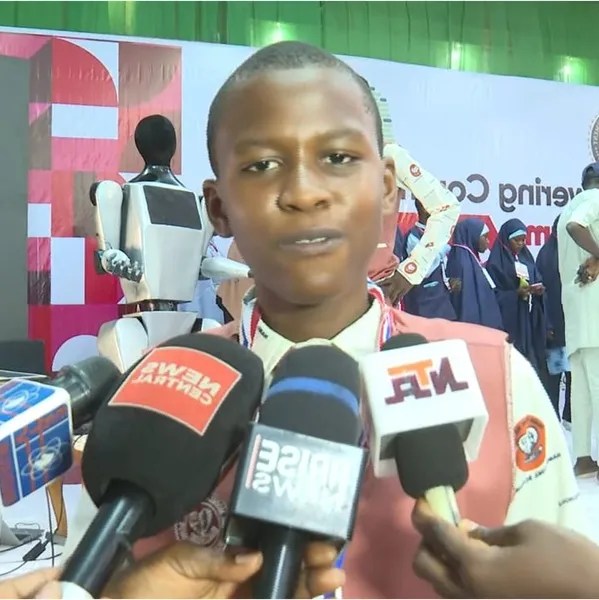
In a groundbreaking development, a team of secondary school students from Borno State has unveiled a homegrown humanoid robot named Max Zulum, designed to revolutionize education in the northeast region of Nigeria. This innovative creation, named after Governor Babagana Umara Zulum, is a testament to the state's commitment to technological advancement and self-reliance. The robot's unveiling took place at the graduation ceremony of the 'Empowering Ideas, Empowering Communities' Artificial Intelligence (AI) Bootcamp and Data-Analytics Fellowship, marking the culmination of a six-month training program funded by Maxzeeton Technology and supported by the Borno State Information and Communication Technology Development Agency (BICTDA).
Max Zulum stands as a symbol of local technological prowess, designed to guide learners step-by-step, especially when faced with challenging mathematical problems. The students, who received training in coding, robotics, AI, and data analytics, collaborated to bring this functional prototype to life. The Managing Director of Maxzeeton Technology emphasized the robot's ability to transform theoretical knowledge into practical solutions, supporting pupils both at home and in the classroom.
One of the developers, Al-mustapha Kabir Matazu, described Max Zulum as a 1.2-meter tall humanoid robot with a display screen embedded in its chest and a speaker-microphone array for two-way voice interaction. Powered by a custom AI engine, it can recognize complex spoken questions and provide verbal explanations. The robot displays step-by-step visual solutions on its screen, focusing on primary-level math and science topics, adapting its pace according to the learner's responses. During the demo, it demonstrated its capabilities by walking through a mathematical problem-solving process, highlighting each step on the screen.
The training program, according to Matazu, progressed from simple coding to full-stack AI, enabling the development of Max Zulum. He emphasized that the robot is a practical solution to the pressing problem of teacher shortages in the education sector, which has been strained by years of insecurity, displacement, and a chronic shortage of qualified teachers. The average learner-to-teacher ratio in Borno State is 46 students per teacher, with regional reports citing even higher peaks in remote or conflict-affected primary schools.
The impact of this innovation extends beyond the classroom. Fatima Abdulrahman, a participant who won the bootcamp's innovation award, expressed her newfound vision of using technology to support learning in unsafe environments. The robot's potential to address teacher shortages and provide educational support in crisis-affected areas is a significant step towards ensuring that children in Borno State continue their education, even in challenging circumstances.
The Max Zulum project also includes a broader initiative by Maxzeeton Technology to onboard 100 youths into the Data Analytics, Artificial Intelligence, and Robotics Fellowship Programme. This program aims to equip university graduates and young people with globally relevant digital skills, preparing them for opportunities in the rapidly evolving technology-driven economy. Engr Kabir Wanori, Executive Secretary of BICTDA, emphasized the importance of building talent that can create wealth and solve real-world challenges, positioning Max Zulum as the first of many locally-crafted solutions for various sectors.
As Max Zulum takes its first steps into the world of education, it represents a significant leap towards a more technologically advanced and self-reliant Nigeria. The robot's ability to provide personalized learning support and address teacher shortages is a promising development, offering a glimpse into a future where technology plays a pivotal role in shaping the country's educational landscape.